Growing up, I always loved the world of athletics, more specifically the storytelling behind it. That’s where my dreams of being a sports broadcaster were born.
In my room, I had a poster of Rowdy Gaines — the “Voice of Swimming” — on my wall.
I remember putting the TV on mute and doing my best Rowdy impression. I would commentate on games myself, telling the stories of the athletes on the screen and yelling with joy when there was a highlight play.
So when I got the chance to work with Rowdy and NBC Sports during the 2024 U.S. Olympic Swimming Trials and the Paris Olympic Games, I knew I had to take full advantage of the opportunity.
Landing the Job
 Me taking a selfie prior to a jam-packed day at the U.S. Olympic Swimming Trials.
While everything that happened this summer came as a bit of a whirlwind, getting to this point was a process years in the making. Before making its way to Indianapolis, the previous four U.S. Olympic Swimming Trials were held in my hometown of Omaha, Nebraska. In 2021, my mother served as the assistant meet director at the trials. This allowed me to work a lot of really cool jobs, shake hands and rub elbows with a lot of higher-ups in the U.S.A. Swimming and World Aquatics scene.
So when I learned that the swim trials were being moved to Indianapolis, I reached out to those connections I made, letting them know about my desire to break into the sports broadcasting realm and asking if there was a way I could work for the NBC crew. I did not care what the job was — driving people around, getting coffee, etc. — I would do whatever it took to not miss out on this opportunity. This paid off, as I was fortunate enough to be added on as a spotter for NBC Sports.
Once I got the position, I did everything I could to make myself stand out. During a production meeting, I overheard Rowdy talking about a few things he needed for his broadcasts. So quietly behind the scenes, I put together a document with all the things he asked for. After the meeting, I went up to him and introduced myself, and he told me I could email the notes I compiled for him. It was kind of a shock at first because here was my childhood idol, someone whose posters I had hanging in my room as a kid, casually asking me to email him. But from there I just kept working hard and as a result, he kept noticing the work I was doing.
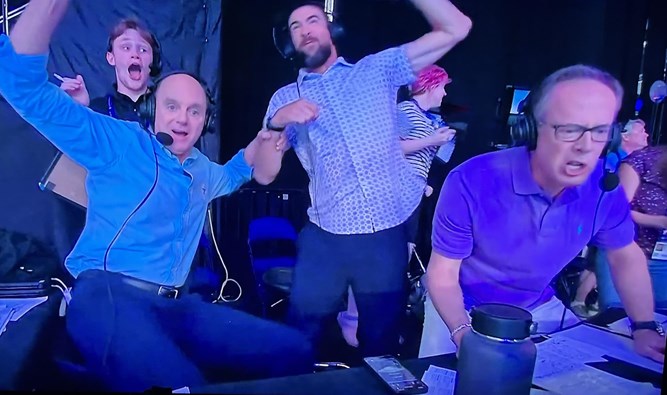 An exciting moment in the action that I got to share with Rowdy Gaines, Michael Phelps, and Dan Hicks.
As the trials progressed, I gradually went from just being a spotter in the booth to personally helping Rowdy and the other broadcasters by gathering notes on the swimmers and races as well as stories and angles they could use to improve their broadcast. One of the other broadcasters I had the pleasure of working with was none other than Michael Phelps, the greatest swimmer of all time. It was amazing to meet him and just see him be a regular dude in the booth and behind the scenes.
As my role continued to expand, I started making in-depth note sheets with analysis on every swimmer, every little storyline, different times, different events, literally anything that could be useful. When I gave this to Rowdy, he was blown away by the detail and effort I put in. For the rest of the event, I continued feeding him as much useful information as possible. Once the trials were over, Rowdy came up to me and said that what I did for him was so unbelievably crucial and it was so fun to work with me that he wanted me to continue working for him as a remote swimming research analyst while he was in Paris! I tried to keep my cool but all I could do was give him the biggest hug possible and thank him a million times over!
Lessons Learned
Throughout the summer, being flexible and confident in myself were probably the most valuable lessons I took from the experience.
If I hadn’t bet on myself and reached out about getting a position with NBC Sports, none of the great experiences I had this summer would have happened. I had to be persistent with the emails I sent out. Doing that taught me that taking a shot, even if it’s a blind shot in the dark, is so worth it. The worst thing that can happen is a no, and a no doesn’t set you back, it gives you another opportunity to move forward.
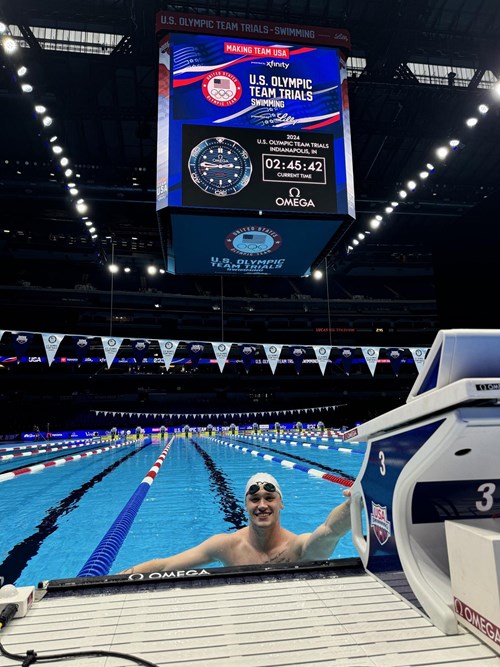 Couldn't leave Indianapolis without jumping in the pool myself!
Once you do get that yes, you have to make the most of every moment, despite the challenges. While I was in Indianapolis, there were days when I was inside Lucas Oil Stadium from 7 a.m. until 11:30 p.m. I was also the youngest member of our crew. During the Olympics, I worked on a seven-hour time difference. With those kinds of obstacles, it would have been easy to feel out of place or that I wouldn’t be able to pull it off, but I knew I belonged because of all the hard work I put in to get there.
Even before my time in Indianapolis, the hard work I put into my own career as a swimmer at Youngstown State did a lot for me in my role as a spotter and research analyst. Being a swimmer and having to analyze my own stroke and my own technique so critically translated seamlessly to what I did for the trials and the Olympics.
It’s so easy for hard work like that to feel like it goes unnoticed, but that was why working for someone like Rowdy was so rewarding. He has done this so well for so long, yet he was willing to listen to me, which made me feel so unbelievably welcomed and confident in the work I was putting in.
A Life-Long Impact
As I reflect on this experience and how it will impact me throughout my career, I think about the advice I received from Rowdy and another legendary broadcaster, Mike Tirico. They both instructed me to never lose my love for the sport and the stories I tell. The best voices in sports are the ones who have charisma, brains and drive to do it, and I know I have all of those qualities in me.
If I had to put a dream to my career goals, it’s not anything physical.
As much as I want to say I’d love to call a Super Bowl or an NBA Finals or the Olympics, what I really want is to be remembered as somebody who people enjoyed listening to.
That’s what makes the best broadcasters legendary. It’s not what they called, it’s how they called it.
And if I can follow in the footsteps of those who have come before me, I’ll be forever grateful for the opportunity to share my love of storytelling and broadcasting with the world.